Teaching and Learning Consulting Network, LLC
Contact us
  • Home
  • About Us
  • Connect With Us
    • Costs
  • Professional Learning
    • 7 PL Standards
    • Adult Learners
    • Change Models
    • Leadership
  • Curriculum
    • Curriculum Design
  • Vicki's Blog

Vicki's Blog

My thoughts on education, improvement, and life itself.  Enjoy!

TLC Home

Lessons from the Busy Bees

7/3/2014

1 Comment

 
Picture
This past month I have been a total busy bee!  The last 3 weeks in particular have been a non-stop whirlwind of activity.  And it wasn't just busy work - that dreaded school term! Much of my time was focused on adult learning that will lead to improved student learning...or at least that is the plan.  

Just as the bees bring nectar from the flowers to the hive to create honey, the educators I have been with during the last 3 weeks will take their new knowledge and skills back to their own classrooms to make a difference in the learning of their students. But as we have learned in my Baker University curriculum course, new knowledge and skills do not necessarily translate into effective implementation.  We have to plan with the end in mind - backwards design seems to work best - so that we provide clear goals, room for inquiry, a plan for assessment, and quality, focused learning experiences to effectively achieve the goal.  But it doesn't matter what we are planning, whether it's our summer vacation, the holiday cookout, adding onto our church, or crafting legislative action, having a vision as to what the result will be must come first or we will unlikely have the end product that we desire! Bees are not random or hope to create honey.  They are on a mission, know what the outcome will be, and DO create honey!

Being busy doesn't mean the goal will be achieved effectively either.  Bees never seem to stop working, buzzing around their hive in a flurry of activity. Their work is purposeful.  They aren't just buzzing to be buzzing.  They are creating honey and each bee has a role to play in that process.  Planning for learning, or any other significant endeavor, also requires careful planning, clearly stated expectations, and fulfillment of the roles and tasks needed to achieve the goal.  When I go to the store each week, it is imperative that I have a list, otherwise I may not come home with the items I really need, or I end up buying things I didn't really need (or already have on hand).  Purposeful planning sets up effective doing!

Which brings us to another lesson from the bees:  one can accomplish a lot more when we work together.  Rarely do you see a hive with only individual bees randomly flying around.  More often than not, you see a thriving, buzzing group of bees busily working at their assigned task.  As I listened and watched the participants in our workshops during the last 2 weeks, I saw a lot of buzzing as they discussed and collaborated to learn as much as possible so they could implement this new learning.  Even as they were mulling over ideas, they were eager to share their new understandings with those in the class and take back to share with their colleagues.  My husband and I would have never been able to remodel our house and transform it from a farm house to a log house without a collaborative working relationship.  As I've noted in previous blogs - he has the ability to take our ideas and make them reality.  Whenever we work together on a project, we utilize each other's strengths to spark ideas, reflect on and revise our plans, and ultimately get the job done.  It is so much easier when we ask for help, or include others in our planning and implementation.  Rarely do any of us have all the answers or all the tools needed to accomplish a task well!  

Bees are persistent too.  The new buzz word in education today is to develop grit. A lot of us lost that skill some time ago when technological advances made life much easier.  But bees can be our inspiration as they continue to find sources of nectar, even if it's a dry year and the flowers aren't blooming like they usually do.  They are focused on the end result and they continue to work until the job is done.  In education, one way to practice and achieve the trait of "grit" is through project based learning.  This involves so much more than just studying or doing research and then writing or answering questions about it.  It involves real world (authentic) application of knowledge and skills to produce a project of value and one that demonstrates true understanding.  It took us nearly 10 years to remodel our house and make the transformation complete.  But persistence won out over limited funds and the temptation to take a break and never start up again.  We started with the end in mind, and found ways to overcome the obstacles and achieve the desired result.  Even today, we still tweak that final product to make it even better.  But then that's another topic for another day!

And now I must get busy.... grading projects awaits!
1 Comment

Bridging the Gap Between Knowing & Doing

6/11/2014

4 Comments

 
Picture
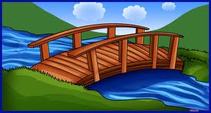
When I was a kid, I had a bad habit of saying, "I know" when my dad would talk to me about something.  He would then say to me, "Well if you know, then why aren't you doing it?"  How often do we "know" but fail to "do?"

After spending the morning in a planning meeting with the executive director of Learning Forward (a professional learning organization for educators), I began to think about the bridge between knowing and doing.  She challenged us as a state organization to get busy, with no excuses, and move from knowing to doing in order to impact the direction of professional learning for educators in our state.  Schools and organizations are notoriously slow to change because we often don't want to leave our comfort zones or fail to provide the necessary education and support to facilitate effective implementation of the desired change.  But schools are not alone in this problem.

I think about how many times we know better, but either don't do what we know we should, or do nothing at all!  The other day when I went to teach my college class, it was seriously raining, yet there were so many cars who didn't have their lights on!  In Kansas, it's a state law to turn on your lights if you are using your windshield wipers.  There are blinkers on every vehicle to signal your intent to turn, yet so many drivers fail to do this simple step.  All these things are designed to keep us safe, to let the other drivers know you're around or your intention to make a change, and yet although we "know," we don't follow through with the "do."

Sometimes we "know" a lot of stuff, but we don't know when or how to use that information.  When we know how to do something and when to do it, then we are applying our knowledge and skills.  The knowledge becomes more than useless trivia, it becomes useful.  When we ask students to do more than memorize and perform rote recall, we are deepening their understanding because now they can actually use what they know.

Doing requires sufficient motivation to act.  No one can make you do anything!  So maybe the first thing we should examine is WHY do we avoid the "doing?"  Sometimes it's because doing means we will become accountable or responsible.  Doing means we have to stop gathering information and move forward. Doing might mean we make a mistake.  Doing makes us uncomfortable when it's not what we usually do!  We know we should be exercising and eating healthy choices and portions.  But we often do - or fail to do - what we know to be the right thing.  Doing may require some discipline on our part, and sometimes it just isn't fun.

But doing is also active and engaging!  Doing makes us feel useful and worthwhile!  The more we do the more experience we gain and the more confidence we build.  Talking about doing something happens all the time and is usually just an exercise in futility.  Letting others do it for you makes you feel helpless or unworthy and offers you no investment.  But doing WITH others is also beneficial too.  No one expects you to do it alone.  Doing requires you get dirty, sweaty, and involved.  And in the end, you can smile and say "I/we did it!"

So instead of just thinking about it, or talking about it, or know you probably should, - just get up and do it!   Cross that bridge from knowing to doing and see what results you get on the other side!   

                                                              **************************

Thinking is easy, acting is difficult, and putting one's thoughts into action is the most difficult thing in the world. 
                                                                     Johan Wolfgang von Goethe, German poet


Action alleviates anxiety.
                                   B.J. Gallagher, Power of Positive Doing


Even if you fall on your face, you're still moving forward.
                                                                         Victor Kiam, businessman


4 Comments

Never too Old to Learn a New Trick or Two

1/2/2013

4 Comments

 
Picture
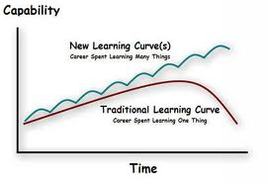
I find myself sitting in front of my computer in this new year feeling the burn as I learn something new.  I'd like to think (as the chart suggests) that I've spent my career learning many new things and that has been to my benefit.  But learning is a choice and something we can easily set aside when it becomes hard or tedious.  The brain, just like the rest of my aging body, falls under the same guideline:  If you don't use it, you'll lose it!

I am getting ready to teach an on-line course on Curriculum Development and Design.  I've taught the class before in face-to-face style (which I prefer), but now I'm going to teach it to a faceless group of students.  I like technology and the amazing things we can do as a result, but I also like the personal connections that one gets from talking to people face-to-face.  I took some on-line classes when working on my Master's degree several years ago, but I had the added benefit of taking the same courses with a friend and colleague with whom I could bounce ideas and make sense out of the learning.  So my challenge is not only to learn how to operate this on-line system, but to help make the impersonal more personal so my students find a connection with me; with each other; with the content; and with their own teaching practice.  I am a story teller and fortunately, I am a writer too.  Hopefully I can blend those two skills into something meaningful.

The irony in this whole situation is that I am having to learn the whole on-line teaching system in my least favorite learning mode... through a pre-recorded webinar.  I am so easily distracted... and that seems to be getting worse with age... and want to "do" while I listen so I can make a connection between what I am learning and what I will need to do.  And because it's pre-recorded, I can't ask questions and have them answered in a timely manner.

Lest you think I'm whining, I'm not.  Because when it is all said and done, I will learn this (I already feel a lot better than I did 2 days ago!), and I will be better for it.  I hope I never get to a point where I think I'm too old to learn something new.  I believe that keeps me informed, interesting (or at least potentially interesting), and in touch.  It may take me longer or require more practice, but it will be worth it in the end. I don't want to be that person who just sits around (although I know how to do that very well!).  Who would want to be friends with me then?  How boring could I become?  How effective would I be as a consultant for schools if I just relied on what I already know instead of learning new things to share with them?

So while I'm not big on New Year's resolutions, I am big on identifying things that I need to do or improve on all through the year.  Staying current with what's happening in education is important to me.  Being able to effectively use technology is important to me as well.  It opens a whole new world... I marvel at what my grandsons can do with their mom's iPad or my iPhone.  They will never know a day when the world will not be at their finger tips.  But you have to access it... you don't get it intravenously!    I may be somewhat retired... but I am always working on upgrading myself!  Happy New Learning!


4 Comments

Professional Learning Standards:  Making Sure the Horse is Before the Cart

11/14/2012

0 Comments

 
Picture
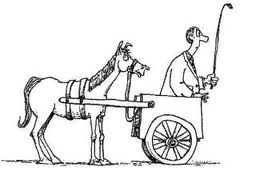
Hmm.... I don't seem to be going anywhere
There's an old saying, "Don't get the cart before the horse."  Why would we ever do that?  But we do it more often than we'd like to admit.  We start taking action before we have all the facts; or we fail to lay the ground work of vision and clarity of purpose before we start; we get in a hurry or we don't really understand the value of the foundation.  And when those things happen, whatever it is we wanted to accomplish often flounders and fails to grow and develop as we had hoped.   We need to know the why and the how before the what can be put into place.  And then we need to look ahead and say "Now what?  So what?"  Getting that horse hooked up to the cart before we start is just the beginning of the journey, but it is an important first step.

Learning Forward (formerly known as the National Staff Development Council or NSDC) has developed  Standards for Professional Learning  for schools to use to help educators become better teachers, which will in turn improve student achievement.  If we put into practice these 7 Standards (which have been adopted by the Kansas State Board of Education to be used in all Kansas schools), then Common Core, or whatever else we want to put in place, will have a much better chance of succeeding.

What are these Standards of Professional Learning?  They are much like K-State Football Coach Bill Snyder's 16 Goals for Success that I talked about in a previous blog.  They give everyone common language and opportunity to understand the "how and the why" so that the "what" can be put into place.

These professional learning standards  address the following concepts and ideals: 
  1. Learning Communities (no more teaching or learning in isolation); 
  2. Leadership (that builds capacity and advocates and supports professional learning); 
  3. Resources (prioritizing and coordinating services); 
  4. Data (to drive teaching and learning);
  5. Learning Designs (research based strategies); 
  6. Implementation (transferring what teachers know to the students); and 
  7. Outcomes (goals and standards to strive for).  

If we stick to the plan, and believe in the direction that it takes us, then these standards can help us with our vision, our designs, our instruction and our results.  If we fail to effectively utilize even one of these 7 standards, then we will fall short.  These standards are important individually, but are most effective if viewed as part of a specific process whereby we look at, discuss, review, and revise all aspects of the education we provide for our teachers and students.  

It is important that all stakeholders understand what each standard entails and the importance of the 7 standards collectively.  School Boards and administrators make decisions everyday that impact the kind and quality of professional learning in schools when creating the school calendar, allocating funds, negotiating with teachers, and by communicating to the public what is going on in their school in terms of teaching and learning.  Teachers need to understand the importance of professional learning and move away from the idea of "in-service" where they typically find themselves disinterested and/or disconnected because they somehow fail to understand the importance of the connection between growing in knowledge and skills,  reflecting on one's own practice, and student learning.  

As educators, we are life long learners, or at least we should be.  The old idea of "in-service" or "professional development" implies that the topics discussed on those days were done "to us" or "for us" rather than "with us."  Professional Learning involves much more than sit and get or one and done.  It involves taking new or different information, ideas, or strategies and determine ways to effectively use the new knowledge or skills in a way that makes us better teachers and helps us produce higher achieving students.  It requires collaboration and support.  By transferring what we learn to the classroom,  the 7 Standards of Professional Learning help us make that connection between knowing and doing by providing a framework and process to ensure regular reflection and revision.

We need to know that what we are learning, why we are learning it, and if our  implementation of that learning in the classroom is making a difference.  We need to help each other by supporting our efforts to improve instruction and student learning.  Regular examination of practice and results will lead us to revisions that fine tune the process and ultimately improve the outcome.  Let's get that horse hooked up and see where it takes us!


Picture
0 Comments

    Author

    Vicki Bechard, 
    Owner and Lead Consultant

    I express myself best when I write, even though most who know me think I talk quite a bit!  

    I'm an educator first and foremost whether my students are kids, teachers, or my own children and grandchildren.  

    Archives

    August 2017
    July 2017
    March 2017
    December 2016
    September 2016
    August 2016
    April 2016
    February 2016
    January 2016
    November 2015
    September 2015
    August 2015
    July 2015
    May 2015
    April 2015
    March 2015
    February 2015
    January 2015
    October 2014
    September 2014
    August 2014
    July 2014
    June 2014
    May 2014
    April 2014
    March 2014
    February 2014
    January 2014
    April 2013
    March 2013
    January 2013
    December 2012
    November 2012
    October 2012
    September 2012
    August 2012

    Categories

    All
    Action
    Anniversary
    Anticipation
    Attitude
    Beginnings
    Be Present
    Blessings
    Bloom
    Bridges
    Change
    Circumstances
    Common Core
    Curriculum Planning
    Doing
    Endings
    Expectations
    Failure
    Fear
    Fight Or Flight
    #ForeverRoyal
    Foundation
    Friendship
    Fun
    Graduation
    Headlines
    Healthy
    Joy
    Kansans Can
    Kansas
    Kinda
    Kindness
    #ksleg
    K State
    K-State
    Leadership
    Lean In
    Life
    Make A Difference
    Memories
    Mom
    Moments
    NCAA Basketball
    Nurses
    Optimism
    Persevere
    Pets
    Photographs
    Play
    Positive Intent
    Prairie Burning
    Pro Bowl
    Productive Struggles
    Professional Learning
    Purpose
    Reflection
    Relationships
    Relevance
    Resiliency
    Resolutions
    Respect
    Response
    Rigor
    Royals
    School Improvement
    School Shooting
    Sorta
    Spring
    Success
    Surviving
    Taken For Granted
    Teachers
    Teamwork
    Thankful
    The Dash
    Understanding By Design
    Weddings
    Why
    Winter
    World Series

    RSS Feed

Contact us at [email protected]
20064 K-92 Hwy, McLouth, KS  66054
913-796-6241